
Five Toxins Lurking In Your Furniture That Might Be Making Your Sick

I recently polled my Instagram community about what non-toxic home topics they most wanted to learn about. Forty percent of you said the same thing: chemicals to beware of.
That didn't surprise me. It's the question underneath every question — when we're swapping out products and rethinking our homes, what we really want to know is why. What exactly are we protecting ourselves from? And is the concern actually warranted?
So I did what I love to do: I went deep. I already had a solid foundation from years of studying this, but I spent additional time diving into scholarly research for this post. And honestly? This work lights me up. The more I learn, the more I feel like I can actually protect my family — and help you protect yours.
Here's what I found. Five toxins hiding in your furniture — the couch you curl up on, the dresser in your baby's room, the "new" smell of that gorgeous piece you just brought home.
New here? Start with The Easy Place to Start with Non-Toxic Living
Why Furniture?
We think a lot about what we eat, what we put on our skin, what we clean with. But furniture? It sits there looking beautiful and we assume it's inert.
It's not.
The average American spends roughly 90% of their time indoors. Your furniture — especially new furniture — is constantly releasing chemicals into the air you breathe and the surfaces your family touches. Some of these chemicals accumulate in your body over years. Others affect your hormones, your nervous system, your children's developing brains.
The good news: awareness is half the battle. You don't need to throw out everything you own. But knowing what's in your furniture helps you make smarter choices going forward — and take a few simple steps to reduce your exposure right now.
Let's get into it.
1. Formaldehyde
If you've ever walked into a furniture store and noticed a sharp, almost eye-watering smell — that's formaldehyde. And it's not just an unpleasant odor. It's a known human carcinogen, classified as such by the International Agency for Research on Cancer (IARC) and the National Toxicology Program.
Where it hides: Formaldehyde is used as a binding agent in pressed wood products — MDF (medium-density fiberboard), particleboard, and plywood. Which means it's lurking in: flat-pack furniture, most dressers and nightstands, the back panels of bookcases, kitchen cabinets, and the subfloor under your laminate flooring. It's also used in fabric finishes that give textiles their "wrinkle-resistant" or "easy-care" properties.
What the research says: Formaldehyde off-gasses — meaning it releases into the air as a gas — for months to years after a product is manufactured. Chronic low-level exposure has been linked to respiratory issues, eye and throat irritation, and increased cancer risk, particularly nasopharyngeal cancer and leukemia. Children and pregnant women are especially vulnerable because their cells are dividing rapidly, making them more sensitive to DNA-damaging compounds.
What to do:
Choose solid wood furniture (not MDF or particleboard) — especially in bedrooms and nurseries where you spend the most time sleeping and breathing
Look for GREENGUARD Gold or CARB Phase 2 certification on any pressed wood purchases — these limit formaldehyde emissions
If you've just brought home pressed wood furniture, ventilate aggressively: open windows, run a HEPA air purifier, and let it off-gas before using it daily
Vintage solid wood furniture from before the 1980s is often safer than new budget furniture — and way more beautiful
Affiliate note: I've curated my favorite GREENGUARD Gold certified furniture and HEPA air purifiers in my ShopMy shop here → — these are the brands I actually trust and use.
2. Flame Retardants
This one is tricky because flame retardants were originally added to furniture with good intentions. But as research has accumulated, we've learned that many of these chemicals cause significant harm — and worse, they don't even work as well as previously claimed.
Where they hide: Foam cushions in sofas and chairs, crib and toddler mattresses, upholstered headboards, carpet padding, and some children's products. Older furniture is often the biggest concern — pieces made before 2015 frequently contain halogenated flame retardants that have since been restricted.
What the research says: The class of chemicals known as halogenated flame retardants — including PBDEs (polybrominated diphenyl ethers) — are persistent, bioaccumulative toxins. They build up in the body over time and don't break down easily in the environment or in us. Studies have linked PBDE exposure to thyroid hormone disruption, reproductive harm, neurodevelopmental issues in children, and reduced IQ. A landmark study found PBDEs in the breast milk of American mothers at levels significantly higher than European women — reflecting how heavily these chemicals were used in US products for decades.
Even the newer "replacement" flame retardants introduced after PBDEs were phased out are raising red flags. Many appear to have similar mechanisms of harm. We traded one problem for another.
What to do:
When purchasing upholstered furniture or mattresses, specifically ask: "Does this contain added flame retardants?" Manufacturers aren't required to disclose this — but most will tell you if you ask
Choose naturally flame-resistant materials: wool, latex, and leather are inherently less flammable and don't need chemical treatment
For mattresses: look for GOLS-certified organic latex or GOTS-certified organic cotton with no added flame retardants
[Internal link: See How to Design a Non-Toxic Nursery for my full mattress and furniture recommendations →]
My current favorites: Naturepedic and Avocado Green are the brands I point every mama to. Both are transparent about their materials and both are genuinely beautiful. Shop them here via my ShopMy →
3. PFAS ("Forever Chemicals")
PFAS — per- and polyfluoroalkyl substances — have become one of the most talked-about environmental health concerns of the past decade. And for good reason. There are over 12,000 PFAS compounds, they are virtually indestructible in the environment, and they accumulate in human tissue. The nickname "forever chemicals" is unfortunately accurate.
Where they hide in furniture: Stain-resistant and water-repellent fabric treatments are the big one. That Scotchgard coating on your sofa? Historically made with PFAS. Stain-resistant carpet treatments. Water-repellent outdoor cushions. Many "performance fabrics" marketed as easy-clean. PFAS are also used in some leather and wood finishes marketed as water-resistant.
What the research says: PFAS exposure has been linked to thyroid disease, immune disruption, certain cancers (kidney and testicular in particular), reproductive harm, elevated cholesterol, and hormone disruption. They've been detected in blood samples from virtually every American tested, in breast milk, in cord blood — meaning babies are born with PFAS exposure already on board from their mothers.
What makes PFAS particularly alarming for furniture is that these treatments don't stay put. PFAS leach into house dust, which is ingested by children who touch floors and put their hands in their mouths. Studies of house dust consistently find elevated PFAS levels — and children have higher body burdens than adults as a result.
What to do:
Avoid furniture marketed as "stain-resistant," "water-repellent," or treated with Scotchgard unless the brand explicitly confirms PFAS-free treatment
Choose untreated natural fabrics: linen, wool, and undyed organic cotton don't require chemical treatments to look good and wear well
HEPA vacuum and wet-mop regularly to reduce PFAS-laden dust — especially in rooms where little ones spend time on the floor
Look for OEKO-TEX Standard 100 and bluesign certifications — both restrict PFAS
What I use: Natural linen and wool upholstery, full stop. No performance fabric needed when the material is already beautiful and breathable. I have some of my favorite certified-clean textile brands linked in my ShopMy →
4. Benzene
Benzene is a volatile organic compound (VOC) — one of many chemicals that evaporate from furniture, paint, flooring, and adhesives into indoor air. But benzene deserves its own spotlight because it's classified as a Group 1 human carcinogen by the IARC. There is no safe level of benzene exposure.
Where it hides: Benzene is found in the adhesives used to bond furniture components, in some synthetic carpet fibers, in varnishes and lacquers used to finish wood furniture, in foam products, and in the general off-gassing of new synthetic materials. It's a key component of that distinctive "new furniture smell" — which, as we now know, is VOCs literally evaporating into your home. Benzene can hide in a lot of other places, see non-toxic alternatives here!
What the research says: Benzene primarily affects the blood-forming system. Long-term exposure is strongly linked to leukemia and other blood cancers. Even short-term high-level exposure causes dizziness, headaches, and neurological symptoms. The EPA lists benzene as a major indoor air pollutant, and studies consistently find that benzene concentrations inside homes can be significantly higher than outdoors — especially in newly furnished or renovated spaces.
The aerosol dry shampoo recalls of 2022-2023 brought mainstream attention to benzene contamination. But benzene in furniture off-gassing has been a documented concern for decades — we just haven't talked about it enough.
What to do:
Ventilate new furniture before bringing it fully into your home — a garage or well-ventilated space for even a few days makes a difference
Choose water-based finishes rather than solvent-based varnishes and lacquers
Run a HEPA air purifier with activated carbon — activated carbon specifically absorbs VOCs including benzene, which HEPA filtration alone cannot capture
Open windows daily — even 10 minutes of cross-ventilation measurably reduces indoor VOC levels
Air purifiers I actually trust: I've tested several and linked my favorites in my ShopMy → — look for the Non-Toxic Home collection. Air Doctor is my top pick for activated carbon filtration.
5. PVC (Polyvinyl Chloride)
PVC — polyvinyl chloride — is one of the most widely used plastics in the world, and one of the most problematic from a health standpoint. It's earned the nickname "the poison plastic" in research literature, and it's everywhere in conventional furniture.
Where it hides: Faux leather and vinyl upholstery (that gorgeous "leather look" sofa that's actually vinyl), vinyl flooring and baseboards, shower curtain liners, the edgebanding on pressed wood furniture, some children's furniture, and cable management components.
What the research says: PVC is inherently unstable as a plastic and requires the addition of plasticizers — most commonly phthalates — to become flexible. Phthalates are endocrine disruptors that leach out of PVC over time. They've been linked to hormonal disruption, reproductive harm, obesity, and developmental issues in children. Numerous phthalate compounds are now restricted in children's products in the US and EU — but adult furniture remains largely unregulated. The "new plastic smell" of vinyl upholstery? That's off-gassing phthalates.
PVC also creates problems at the manufacturing and disposal stage — its production generates dioxins, and it's nearly impossible to recycle. It is, genuinely, one of the worst materials you can have in your home.
What to do:
Choose genuine leather, wool, linen, or organic cotton upholstery instead of vinyl or faux leather — the real thing looks better, lasts longer, and doesn't off-gas
Avoid cheap LVP vinyl flooring in rooms where children spend time on the floor; solid hardwood, cork, or tile are safer and honestly more beautiful
For shower curtains: this is one of the easiest swaps — switch to a fabric liner or PEVA option. Real upgrade for minimal cost.
When buying children's furniture and toys, look for solid wood with water-based paint and natural fabric upholstery
[Internal link: See Non-Toxic Kitchen Swaps for more easy wins around the home →]
The Big Picture
None of this is meant to send you into a spiral. I say this every time and I mean it: you cannot swap everything overnight, and perfectionism is not the goal.
What I want you to walk away with is a framework. When you're shopping for furniture — a new couch, a nursery dresser, a toddler bed — you now have five things to look for and ask about. Over time, as you replace pieces naturally, you can make better choices. And in the meantime, a few simple daily habits go a long way:
Run a HEPA air purifier with activated carbon
Open windows for 10 minutes daily
Vacuum regularly with a HEPA vacuum
Wet-mop hard floors to capture settled dust
Your home should be a refuge, not a source of harm. And the fact that you're reading this means you're already doing the most important thing: paying attention.
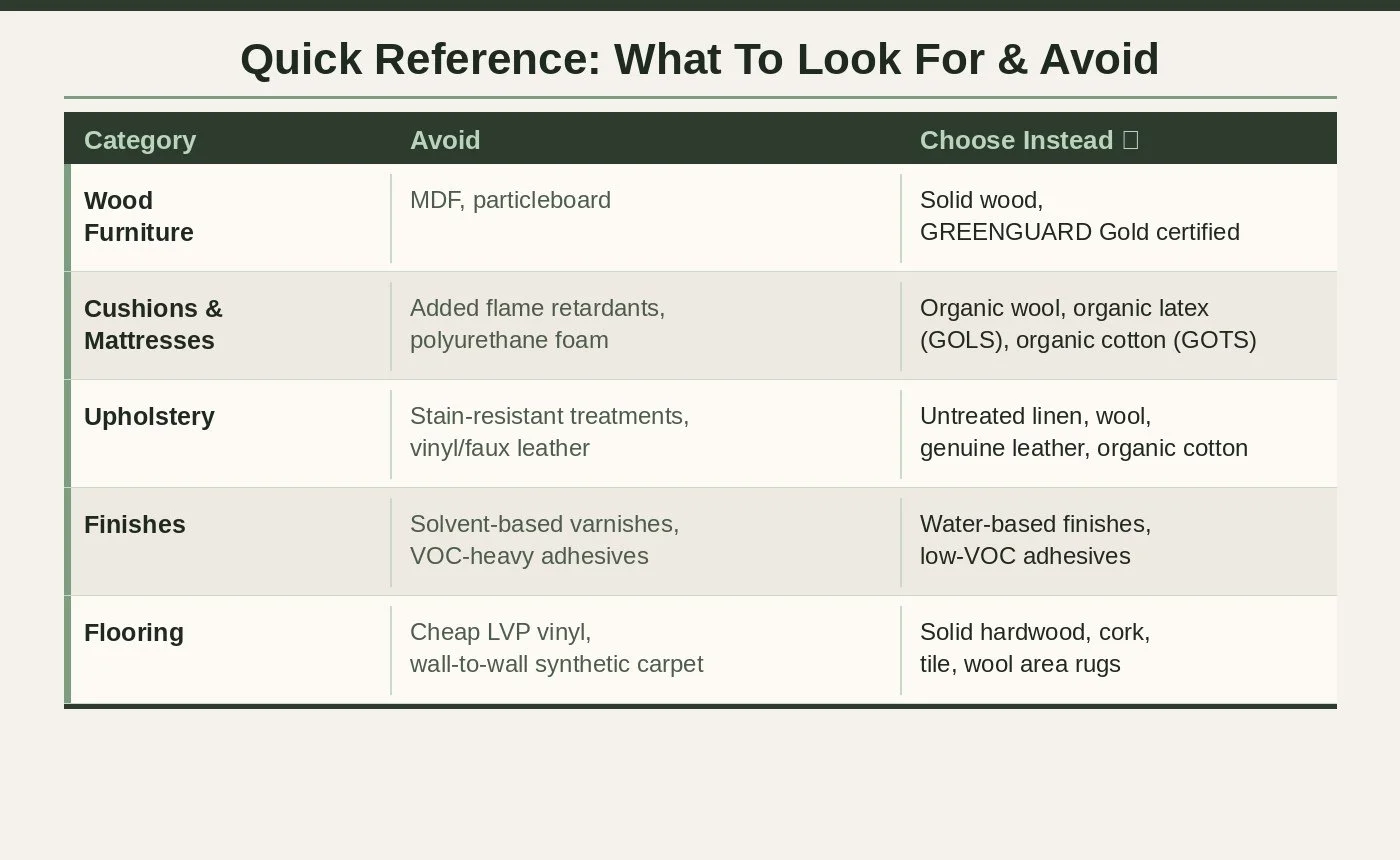
Quick Reference: What To Look For (And Avoid)
Ready To Make The Swap?
I've done the sourcing work for you. My Non-Toxic Home ShopMy collection → includes the HEPA air purifiers, organic mattresses, and clean home brands I actually use and trust — no guesswork required.
If you're newer to this world, I'd start in the kitchen — it's where I see the biggest bang for your buck. My Non-Toxic Kitchen Swaps post walks you through exactly where to begin.
Holistic With Heidi is a non-toxic living resource for non-toxic moms. This post contains affiliate links — I only recommend brands I genuinely use and trust. This post is for educational purposes and does not constitute medical advice.
FAQs
What are the most toxic chemicals in furniture?
The five most common toxic chemicals found in conventional furniture are formaldehyde (in pressed wood and fabric finishes), flame retardants (in foam cushions and mattresses), PFAS or "forever chemicals" (in stain-resistant fabric treatments), benzene (in adhesives, varnishes, and off-gassing from synthetic materials), and PVC or polyvinyl chloride (in vinyl upholstery and flooring). Each of these has been linked to health concerns including hormone disruption, cancer risk, and developmental issues in children.
Does new furniture off-gas harmful chemicals?
Yes. New furniture — especially pieces made with pressed wood (MDF or particleboard), foam cushions, synthetic fabrics, or solvent-based finishes — releases volatile organic compounds (VOCs) including formaldehyde and benzene into indoor air. This off-gassing is most intense in the first weeks after purchase but can continue for months to years at lower levels. To reduce exposure, ventilate new furniture in a well-aired space before use, run a HEPA air purifier with activated carbon, and open windows daily. Place in the sun if you can for the best off-gassing scenario, the sun works wonders here!
How do I know if my furniture contains formaldehyde?
Furniture made with MDF (medium-density fiberboard), particleboard, or plywood almost always contains formaldehyde-based adhesives. This includes most flat-pack furniture, budget dressers, bookcase back panels, and kitchen cabinets. If furniture has a sharp chemical smell when new, that's a sign of formaldehyde off-gassing. Look for GREENGUARD Gold or CARB Phase 2 certification to find lower-emission options, or choose solid wood furniture which avoids the issue entirely.
Are flame retardants in sofas dangerous?
Many flame retardants used in sofa foam cushions — particularly older halogenated flame retardants like PBDEs — have been linked to thyroid hormone disruption, reproductive harm, and neurodevelopmental issues in children. PBDEs are persistent and bioaccumulative, meaning they build up in the body over time. While the most harmful compounds have been restricted since 2015, replacement flame retardants are now raising similar concerns. When purchasing upholstered furniture, ask specifically whether it contains added flame retardants and look for naturally flame-resistant materials like wool or latex instead.
What is the safest type of sofa to buy?
The safest sofas are made with a solid wood or metal frame (not particleboard), cushions filled with organic wool, natural latex (GOLS-certified), or organic cotton (GOTS-certified) with no added flame retardants, and upholstered in untreated natural fabrics such as linen, wool, or genuine leather. Avoid sofas with stain-resistant fabric treatments, vinyl or faux leather upholstery, or foam cushions treated with chemical flame retardants. Brands that are transparent about their materials and hold GREENGUARD Gold certification are worth prioritizing.
How do I reduce toxins in my home from furniture?
You don't need to replace everything at once. The most impactful steps are: run a HEPA air purifier with activated carbon in rooms where you spend the most time (this captures both particles and VOCs), open windows daily for at least 10 minutes to dilute indoor air pollutants, vacuum with a HEPA vacuum and wet-mop hard floors regularly to reduce PFAS-laden dust, ventilate new furniture before bringing it indoors, and prioritize swapping out the most problematic pieces first — foam mattresses and upholstered items in bedrooms and nurseries where you spend the most time sleeping.
Is vinyl (PVC) flooring safe for children?
Conventional PVC vinyl flooring — including many popular luxury vinyl plank (LVP) options — can contain phthalates, which are endocrine-disrupting plasticizers that leach from the material over time and accumulate in house dust. Children are at higher risk because they spend more time on the floor and have more hand-to-mouth contact with dust. Safer flooring options for children's rooms include solid hardwood with water-based finish, cork, ceramic tile, or wool area rugs over hard floors. If replacing flooring isn't possible, HEPA vacuuming and wet-mopping frequently reduces dust-based exposure significantly.
Holistic With Heidi is a non-toxic living resource for non-toxic moms. This post contains affiliate links — I only recommend brands I genuinely use and trust. This post is for educational purposes and does not constitute medical advice.